

The Ultimate Guide to Creating an SEO Topical Map in 2026
In 2026, search engines no longer rank isolated keywords; they rank interconnected entities. A topical map is the structural plan that transforms a disjointed blog into a highly authoritative semantic resource. This guide breaks down exactly how to build, automate, and measure a topical map to lead your market.
What is a Topical Map in SEO?
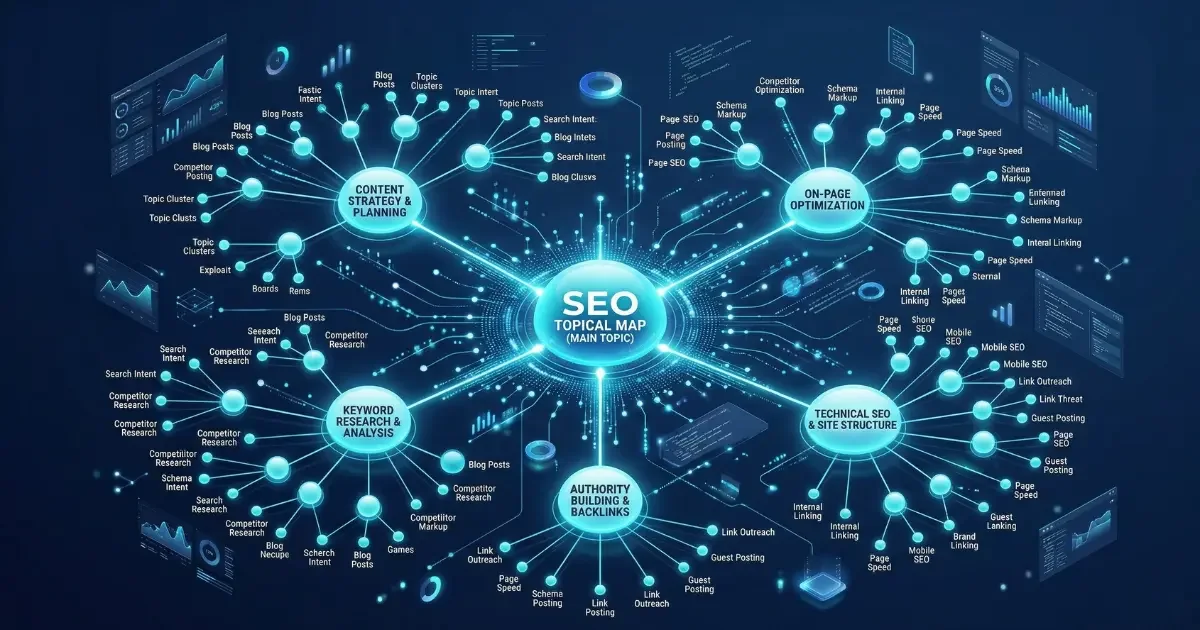
A topical map is a strategic, visual outline that organizes a website's content around a central entity and its branching subtopics. It maps out the semantic relationship between pillar pages and cluster content, proving to search engines that your site possesses comprehensive expertise on a specific subject. A topical map prioritizes entity relationships over raw search volume, unlike a traditional keyword list. This structure aligns perfectly with the core principles of modern search engines, lowering the cost of retrieval by presenting information in a highly organized, predictable format. You build a strong foundation for your entire content strategy when you understand what is topical authority in SEO and apply this structural plan.
Why Topical Mapping is the Key to Topical Authority
Before diving into the creation process, it is crucial to understand why topical maps are the primary system powering modern semantic SEO success.
Technical SEO Benefits (Crawlability & Link Equity)
A logical map creates an efficient crawl budget. Search engine crawlers discover new pages easily through structured internal linking. This architecture distributes link equity seamlessly from the pillar to the clusters. You maximize the value of every backlink when the internal network passes authority systematically to all related subtopics.
Preventing Keyword Cannibalization
Mapping search intent to specific URLs prevents multiple pages on your site from competing for the same search engine results page positions. Every node on the topical map serves a distinct purpose. Search engines understand exactly which page to rank for a specific query when you eliminate overlapping content.
Enhancing User Experience and Engagement
Logical content pathways keep users on the site longer. This logical flow reduces bounce rates and signals high engagement to search engines. According to recent industry studies, pages with high topical authority gain traffic 57% faster than those with low authority. Furthermore, research reveals that 88% of SEO professionals consider topical authority critical for ranking success. You accelerate your overall traffic growth when you learn how to build topical authority using a structured map.
How to Create a Topical Map (4-Step Framework)
Building a topical map requires a systematic approach, moving from a broad central entity down to granular, highly specific subtopics. Follow these 4 sequential steps to structure your content network.

Step 1: Define Your Core Entity (Pillar Topic)
Identify the central node of your map. This should be a broad, highly relevant entity that aligns with your brand's core offering. Examples of core entities include SEO Content Automation, Customer Relationship Management, and Artificial Intelligence. You must select an entity that offers enough depth to support dozens of supporting articles.
Step 2: Extract Subtopics and Semantic Keywords
Break down the core entity into its defining attributes and related concepts. Move beyond search volume and focus on semantic relevance and prominence. You must identify the unique, root, and rare attributes that define the entity comprehensively.
Step 3: Map Content to Search Intent
Assign a specific search intent to every node on the map. Ensure that each page serves a distinct purpose in the user journey. Group these intents into informational, commercial, and transactional categories. You guide the user seamlessly toward conversion when you align the content format with the exact search intent.
Step 4: Design the Internal Linking Architecture
Establish the contextual links. Define exactly how the pillar page will link to the subtopics, and how sibling pages will interlink to form a complete semantic network. Use exact-match or highly relevant semantic anchor text when linking from the pillar to the cluster. Implement breadcrumb navigation and ensure sibling pages link to one another to distribute Topical PageRank evenly across the category. Read our ultimate guide to SEO content automation to understand how to scale this architecture efficiently.
How to Use AI to Build Topical Maps Faster
Manual mapping in spreadsheets is obsolete; modern SEOs leverage AI and automation platforms to generate semantic clusters instantly.
Best Prompts for ChatGPT and Claude
Large language models accelerate the research phase when given precise instructions. Use these specific prompts to instruct LLMs to act as an SEO architect, extracting entities and grouping them by search intent rather than just keyword matching.
Entity Extraction Prompt: "Act as an expert Semantic SEO architect. Identify the core entity, primary attributes, and related sub-entities for the topic '[Insert Topic]'. Output the results in a hierarchical list."
Intent Mapping Prompt: "Categorize the following list of subtopics for '[Insert Topic]' based on user search intent (Informational, Commercial, Transactional). Suggest one specific URL slug for each subtopic."
Gap Analysis Prompt: "Analyze this list of existing content for the entity '[Insert Topic]'. Identify missing semantic nodes and suggest 5 new topics to complete the knowledge graph."
Automating with MantaSEO
MantaSEO replaces manual prompting by automatically discovering market gaps, structuring content plans, and generating ready-to-execute topical maps based on real-time SERP data. By utilizing MantaSEO's all-in-one platform, you eliminate human error and accelerate execution when you utilize dedicated “topical map tools”. These platforms build complete topic hierarchies that serve both traditional search engines and generative AI models.

Real-World Topical Map Examples
To visualize how this semantic theory applies to actual websites, let's examine two distinct business models and their corresponding map structures.
Example 1: B2B SaaS
A B2B software company requires a map that targets enterprise decision-makers. The central entity is "CRM Software". The clusters include "CRM for Real Estate", "Sales Pipeline Management", and "Lead Scoring Methods". Implementing a brand-aligned topical map systematically increases organic traffic by capturing highly specific, intent-driven queries.
Example 2: E-Commerce Store (Car Care & Automotive Accessories)
An e-commerce brand requires a map that balances product pages with informational content. The central entity is the category page, such as "Car Care Products". The clusters include supporting informational blog posts about product usage, material durability, and maintenance guides. In a recent MantaSEO case study for a Car Care & Automotive Accessories client, the team successfully led a comprehensive SEO campaign that produced significant organic growth. This topical map implementation generated over 37,100 total organic clicks and 2.14 million total impressions. This structure provides data directly to the Knowledge Graph, proving the brand's expertise beyond just selling products.
How to Measure the ROI of Your Topical Map
Measure the ROI of your topical map by tracking impression growth and time-to-visibility for specific content clusters in Google Search Console (GSC). Use Google Search Console (GSC) to track impression growth by filtering the "Performance" report using a "URL containing" regex for your specific cluster's subfolder (e.g., /crm-software/). Measure the "time to visibility" to prove acquired topical authority. Insights from 2026 industry reports highlight that establishing topical authority accelerates ranking timelines for new content, lifting existing page positions and expanding organic visibility across an entire keyword territory. You confirm the effectiveness of your Topical PageRank flow when new cluster articles rank within days instead of months.
Common Topical Mapping Mistakes to Avoid
Avoid these critical topical mapping errors to prevent content obsolescence and ensure search engines can properly crawl your semantic network:
Set and Forget: Ignoring content obsolescence and map maintenance leads to outdated information. You must update the map continuously as new entities emerge in your industry.
Volume over Entity Relevance: Mapping based solely on search volume rather than entity relevance destroys the semantic structure. You dilute your core expertise when you target high-volume, irrelevant keywords.
Orphaned Pages: Neglecting the internal linking architecture creates isolated content. You must connect every page to the broader network to ensure proper crawling and indexing. Perform a regular Content Audit to identify and fix these disconnected nodes.
Frequently Asked Questions (FAQs)
How long does it take to build topical authority?
Building topical authority typically takes 3 to 6 months, depending on the niche's competitiveness and your publishing velocity. Search engines need time to crawl, index, and evaluate the semantic relationships across your newly mapped cluster.
What is the difference between a topical map and keyword research?
Keyword research focuses on isolated search queries and search volumes, often leading to disjointed content. A topical map focuses on entities and their semantic relationships, organizing content into a structured hierarchy of pillar pages and supporting clusters.
Do I need a topical map for a small website?
Yes. Even small websites benefit from topical maps because they establish a clear site architecture from day one. This prevents future keyword cannibalization and ensures every new piece of content contributes to your overall topical authority.
Conclusion
A well-structured topical map is the foundation of modern semantic SEO. It transforms random blog posts into a cohesive, authoritative network that search engines trust and users find genuinely helpful. You lead your market when you stop targeting individual keywords and start building comprehensive entity relationships. To automate this entire workflow—from entity extraction to cluster mapping and semantic writing—explore how MantaSEO provides an all-in-one platform to scale your topical authority effortlessly.